Press kit
Writing about Hootshell?
Everything you need in one place: what the books are, the facts, the author, and images you may use.
In one line
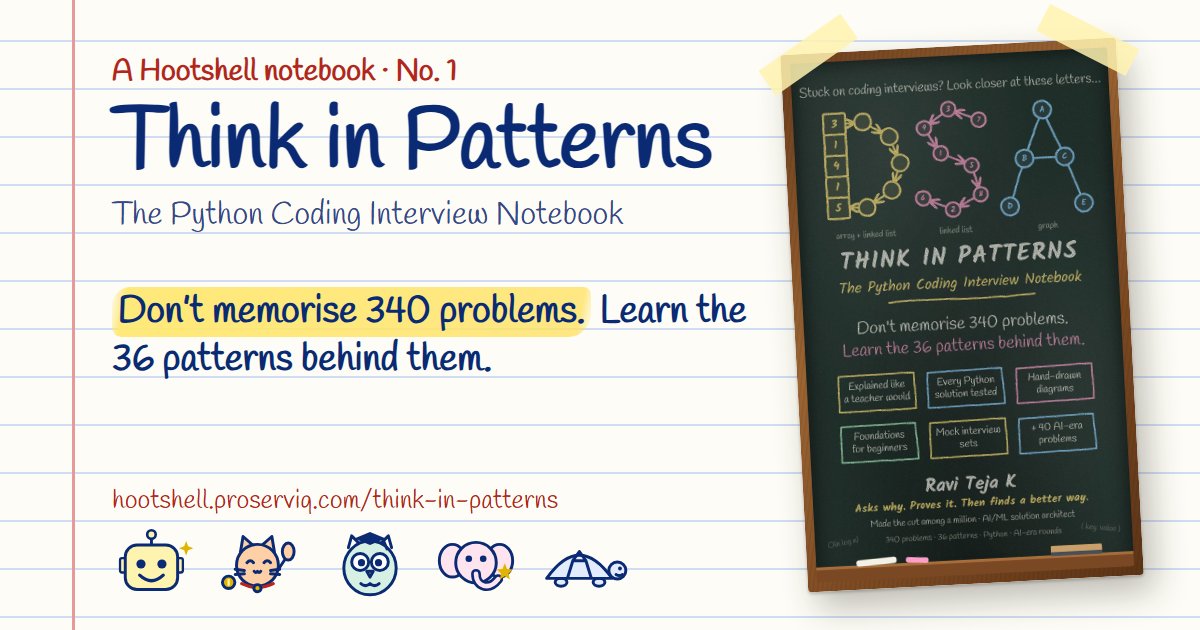
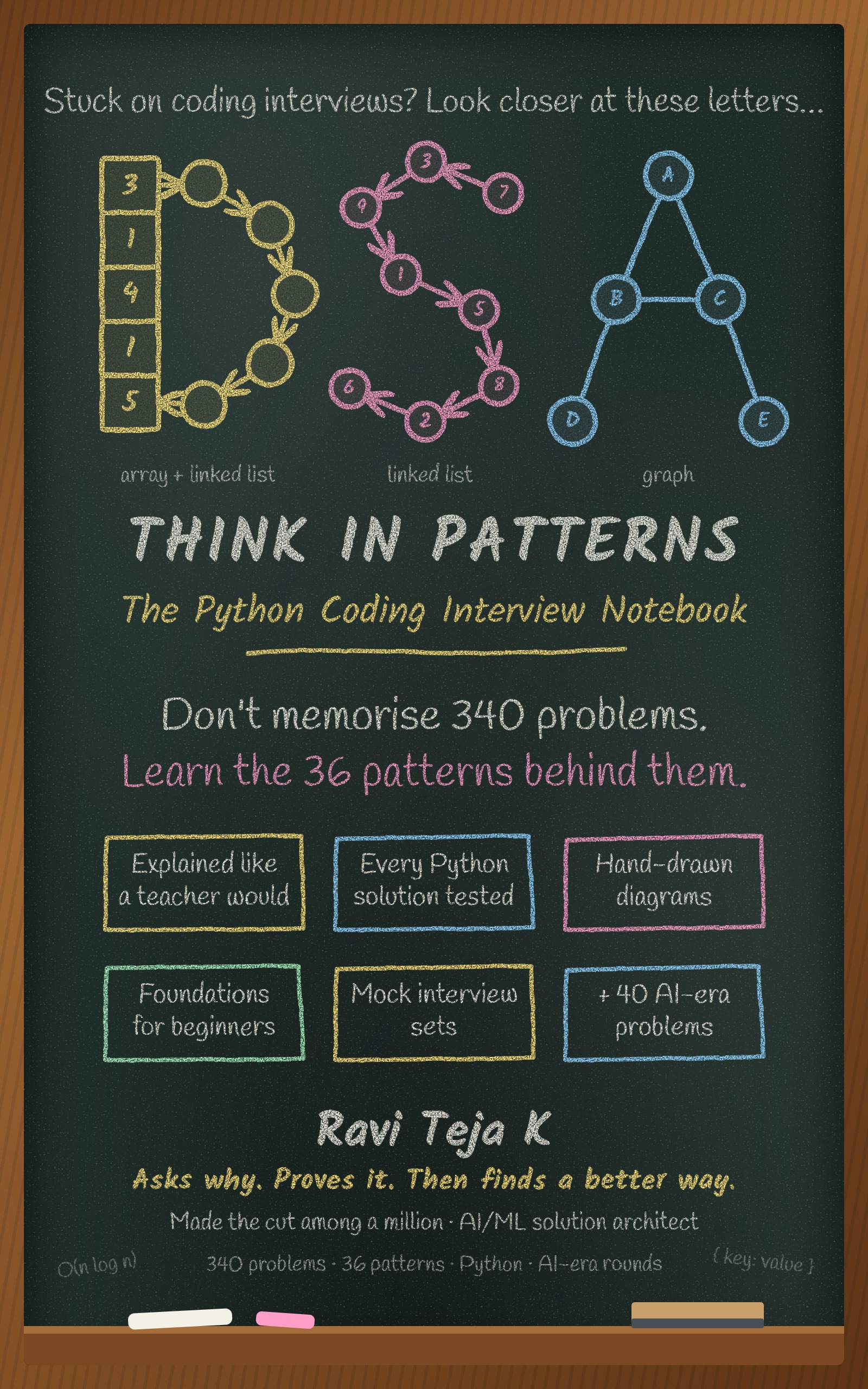
Hootshell makes handwritten-style notebooks that teach. The first, Think in Patterns: The Python Coding Interview Notebook, teaches coding interviews through 36 patterns instead of 340 memorised answers.
In a paragraph
Coding interviews look endless: thousands of problems, new ones every week. Look closer and the same few dozen ideas keep coming back in new clothes. Think in Patterns is written like a patient teacher’s notebook. Every problem starts with an everyday scene, then walks through the obvious answer, the better one, a drawing of the key moment, pseudocode, tested Python, why it works, a dry run and the mistakes people make.
The facts
- 2,288 A4 pages, PDF, Edition 1.1 (November 2026).
- 340 problems (300 classic and 40 AI-era) in 36 patterns, 13 Foundations topics for beginners.
- 913 answers, each linked from its exercise and back; every one of the 353 Python solution files runs against its tests before release.
- Three routes through the book, 8-week and 14-day plans, and a tracker with re-solves at 3, 10 and 30 days.
- Price: $29 launch price (regular $39); ₹699 in India. A free 42-page sample.
- Not affiliated with LeetCode or any company named in the book.
The author
Short: Ravi Teja K writes the Hootshell notebooks. Asks why. Proves it. Then finds a better way. Made the cut among a million · AI/ML solution architect.
Longer: Ravi Teja K studied electronics at NIT Goa and finance at business school, then spent two and a half years at a global bank automating payment operations and doing early machine learning and data work. Today Ravi is a senior AI/ML engineer and solution architect, whose work is taking messy processes nobody fully understands, finding the rule hidden inside, and rebuilding them so every number has a reason and every result is tested. Think in Patterns is written the same way: ask why a solution works, prove it, then look for a better one.
In the author’s own words (for quoting): “I studied electronics at NIT Goa and finance at business school, then spent two and a half years at a global bank automating payment operations and doing my first machine learning and data work: fraud-detection models, data pipelines and analytics dashboards. From there I moved into AI full time. Today I’m a senior AI/ML engineer and solution architect. My work is taking messy processes nobody fully understands, finding the rule hidden inside, and rebuilding them so every number has a reason and every result is tested. I wrote this book the same way: ask why a solution works, prove it, then look for a better one.”
Images you may use
Use these to write about the books, with a link to hootshell.proserviq.com. Please do not change them or use them to sell anything else.


Page images are in the Look inside gallery. To ask about a review copy or an interview, write to contact@proserviq.com.